Scottish forest history. A Bibliography
By the beginning of the 19th century myth of Caledon did not exist in its present form. In 1812 Chalmers introduced the modern concept of the ancient forest of Caledonia in his book Caledonia. It is at this point in time that two different traditions with regard to Scottish forestry separated one of reality and one of myth.
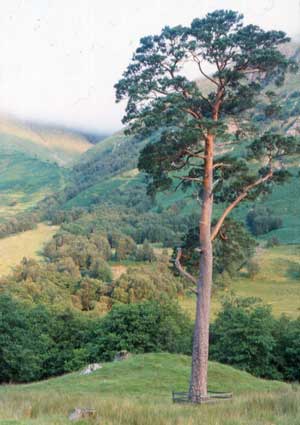
Scots pine in Glen Affric
(photo: Justine Kemp)
The myth proved to be a very powerful story of destruction and decline and is used for political and ideological purposes in connection with environmental issues up to the present day. But the concept of the Caledonian forest must be approached with caution because it is putting the blame of the destruction of Scotland’s native forests on outsiders while there is an abundance of evidence to suggest that locals mainly destroyed the forest.
Although the historical value of the myth of Caledon is dubious its development had certainly its merits. It makes clear that originally Scotland was considerably more wooded than at present and that its decline is almost entirely the work of human hands. This awareness calls for protection of the remnants of old woodlands and using the myth can be the decisive push to convince people to do it.
The disappeared forests of Scotland were also used to justify the creation of modern forestry plantations during the 20th century. However, strategic and economic considerations were more important incentives for the reafforestation of the Scottish uplands. During the First World War Britain was cut off from its overseas timber supplies and had to rely on its own woodlands and forests. The war reduced forest cover in Britain to less than five percent of its total land surface, the lowest ever known, and Britain’s dependence on foreign supplies of timber during times of war became a major concern. In order to rebuild stocks and create a strategic timber reserve the Forestry Act of 1919 was passed and the Forestry Commission was established.
This policy of the creation of a strategic timber reserve by the Zuckerman Committee in 1957 and it was recognised that in case of a Third World War timber reserves would not be crucial. As a result State forestry became to be justified on economic and social grounds. During the 1970s and 1980s forestry in Scotland experienced strong opposition to the creation of large conifer plantations in and in favour of stimulating the regeneration of native species such as Scots pine and oak.
The bibliography below presents a guide to the literature related to the history of the Caledonian forest and the development of Scottish forestry. The bibliography was last updated in 2016.
Anderson, M. L., ‘Forestry Education in Scotland 1854 – 1953’, Scottish Forestry, 8 (1954) 114-126
Anderson, Mark Louden, A History of Scottish Forestry (2 vols, London & Edinburgh: Thomas Nelson and Sons, 1967)
Avery, Mark and Roderick Leslie, Birds and Forestry (London: Poyser, 1990)
Bennett, K. D., ‘The post-glacial history of Pinus sylvestris in the British Isles’, Quaternary Science Reviews, 3 (1984) 133-155.
Bennett, K.D., Fossitt, J.A., Sharp, M.J., Switsur V.R., ‘Holocene vegetational and environmental history at Loch Lang, South Uist, Western Isles, Scotland’, New Phytologist, 114 (1990) 281-298
Carlisle, A., ‘The native Scots pine of Scotland’, Scottish Forestry, 10 (1956) 165.
Crone, Anne and Coralie M. Mills, ‘Seeing the Wood and the Trees: Dendrochronological Studies in Scotland’, Antiquity, 76 (2002) 293, 788-794
Darling, F. Fraser, ‘History of the Scottish Forests’, Scottish Geographical Magazine, 65 (1949)
Darling, F. Fraser, Natural history in the Highlands and Islands, (London, 1947)
Davies, A.L. & Watson, F., “Understanding the changing value of natural resources: an integrated palaeoecological-historical investigation into grazing-woodland interactions by Loch Awe, Western Highlands of Scotland”, Journal of Biogeography, Vol 34, 2007, 1777-1791
Davies, John, The Scottish Forester (Edinburgh: Blackwood, 1979)
Dickson, G.A., ‘Forestry in Speyside in the 1760s’, Scottish Forestry, 30 (1976)
Dickson, J. H., ‘Post-glacial pine stumps in Central Scotland’, Scottish Forestry, 42 (1988) 192-199.
Dickson, J.H., ‘Scottish woodlands: Their Ancient Past and Precarious Future’, Scottish Forestry, 47 (1993) 3, 73-78
Dunn, Malcolm, ‘Forestry in Scotland in the Reign of Her MostGracious Majesty Queen Victoria’,Transactions of the Royal Scottish Aboricultural Society, 15 (1898) 109-129.
Foot, David, Woods and People: Putting Forests on the Map (Stroud: History Press, 2010)
Forbes, A.C., The Development of British Forestry (London: E. Arnold, 1910)
Fowler, John, Landscapes and Lives. The Scottish Forest through the Ages (Edinburgh: Cannongate, 2002)
Fraser Darling, Frank, and Morton Boyd, The Highlands and Islands (Revised edition; London: Oliver and Boyd, 1969)
Fraser Darling, Frank, West Highland Survey: An Essay in Human Ecology (Oxford: Oxford University Press, 1955)
Gear, A. J. and Huntley, B., ‘Rapid changes in the range limits of Scots pine 4000 years ago’, Science, 25 (1991) 544-547
Jeanrenaud, Sally and Jean-Paul Jeanrenaud, Thinking Politically about Community Forestry and Biodiversity: Insider-driven initiatives in Scotland (London: Rural Forestry Development Network, 1997)
Lamb, H. H., ‘Trees and climatic history in Scotland’, Quarterly Journal of the Royal Meteorological Society, 90 (1964) 382-394
Lambert, Robert, ‘Therapy of the Green Leaf’: Public Responses to the Provision of Forest and Woodland Recreation in Twentieth Century Britain’, Journal of Sustainable Tourism, Vol.16 (2008) 4, 408-427
Macdonald, James, ‘Forestry Research and Experiment in Scotland 1845-1953’, Scottish Forestry, 8 (1954) 3, 127-141
Mackay, Donald, Scotland’s Rural Land use Agencies. The History and Effectiveness in Scotland of the Forestry Commission, Nature Conservancy Council and Countryside Commission (Aberdeen: Scottish Cultural Press, 1995)
Mather, Alexander S. (ed.), ‘Afforestation in Britain’, In: Alexander Mather (ed,), Afforestation: Policy Planning and Progress (London: Belhaven Press, 1993), pp. 13-33.
Maxwell, John Stirling, ‘A Decade of State Forestry and its Lessons’, The Scottish Forestry Journal, 44 (1930) 1, 1-6.
Miles, H. & Jackman, B., The Great Wood of Caledon (Lanark, 1991)
Miller, Robert, State forestry for the axe a study of the Forestry Commission and de-nationalisation by the market (London: Institute of Economic Affairs, 1981)
Nairn, David, ‘Notes on Highland Woods, Ancient and Modern’, Transactions of the Gaelic Society of Inverness, 17 (1891), 170-221
Oliver, Susan, ‘Planting the Nation’s “Waste Lands”: Walter Scott, Forestry and the Cultivation of Scotland’s Wilderness’, Literature Compass, 6 (2009) 3, 585–598
Oosthoek, Jan, “Worlds Apart? The Scottish Forestry Tradition and the Development of Forestry in India”, Journal of Irish and Scottish Studies, Vol 3 (2010) issue 1, 69-82
Oosthoek, K. Jan, Conquering the Highlands. A history of the afforestation of the Scottish uplands (Canberra: ANU Press, 2013)
Penistan, M. J., ‘The Caledonian pine forest’, Quarterly Journal of Forestry, 36 (1942) 59-69.
Pringle, Douglas, The First 75 Years. A brief Account of the History of the Forestry Commission(Edinburgh: Forestry Commission, 1994)
Rackham, Oliver, Trees and woodland in the British landscape: the Complete History of Britain’s Trees, Woods and Hedgerows (London: Phoenix Press, 2001)
Robbins, Paul and Alistair Fraser, ‘A Forest of Contradictions: Producing the Landscapes of the Scottish Highlands’, Antipode, 35, (2003) 1, 95-118
Rowe, W.H., Our Forests (London: Faber & Faber, 1947)
Ryle, George B., Forest Service. The First Forty-five Years of the Forestry Commission of Great Britain(New Abbot: David and Charles, 1969)
Sansum, Philip, ‘Argyll Oakwoods: Use and Ecological Change, 1000 to 2000 AD – a Palynological-Historical Investigation’, Botanical Journal of Scotland, 57 (2005) 1, 83-97
Smout , T.C.(ed), Scottish Woodland History (Edinburgh: Scottish Cultural Press, 1997)
Smout, T.C. (ed.), People and woods in Scotland: a history (Edinburgh: Edinburgh University Press, 2003)
Smout, T.C. & Watson, F.J., ‘Upland Wood Pasture: Scottish Woodland History Discussion Group Autumn 2000 Conference Report’, Scottish Forestry, 55 (2001), pp. 33-35
Smout, T.C., ‘Oak as a Commercial Crop in the Eighteenth and Nineteenth Centuries’, Botanical Journal of Scotland, 57 (2005) 1, 107-114
Smout, T.C., ‘The Pinewoods and Human Use, 1600-1900’, Forestry, 79 (2006) 3, 341-349
Smout, T.C., Alan R. MacDonald and Fiona Watson, A History of the Native Woodlands of Scotland, 1500-1920 (Edinburgh: University Press, 2005)
Steven, H. M. & Carlisle, A., The Native Pinewoods of Scotland (Edinburgh & London, 1959).
Steven, H. M., ‘The Forests and Forestry of Scotland’, Scottish Geographical Journal, 67 (1951) 2, 110 -123
Stewart, Mairi, Voices of the Forest: A Social History of Scottish Forestry in the Twentieth Century (Edinburgh: Birlinn, 2016)
Stirling Maxwell, John, Loch Ossian Plantations (Glasgow, 1913)
Tipping, R., ‘The History of the Scottish Forests revisited – Part 1 & 2’, Reforesting Scotland, 8 & 9 (1993) 16-21, 18-21.
Tipping, Richard, ‘Blanket peat in the Scottish Highlands: Timing, Cause, Spread and the Myth of Evironmental Determinism’, Biodiversity and Conservation, 17 (2008) 9, 2097-2113.
Tipping, Richard, ‘The Form and Fate of Scotland’s Woodlands’, Proceedings of the Society of Antiquaries of Scotland, 124 (1994), 1-54
Tittensor, Ruth, From Peat Bog to Conifer Forest: An Oral History of Whitelee, its Community and Landscape (Chichester: Packard Publishing, 2009)
Tompkins, Steve, Forestry in Crisis: The Battle for the Hills (London: Christopher Helm, 1989)
Tsouvalis, Judith and Charles Watkins, ‘Imagining and Creating Forests in Britain, 1890-1939’, in: Mauro Agnoletti and Steven Anderson (eds), Forest History: International Studies on Socioeconomic and Forest Ecosystem Change (Wallingford: CABI, 2000)
Tsouvalis, Judith, A Critical Geography of Britain’s State Forests (Oxford: Oxford University Press, 2000)
Warren, Charles, ‘“Birds, Bogs and Forestry” Revisited: The Significance of the Flow Country Controversy’,Scottish Geographical Journal, 116 (2000) 4, 315-337
Zehetmayr, J. W. L., ‘Afforestation of Upland Heaths’, Forestry Commission Bulletin 32 (London: HMSO, 1960)


Recent Comments