The Little Ice Age was a period of regionally cold conditions between roughly AD 1300 and 1850. The term “Little Ice Age” is somewhat questionable, because there was no single, well-defined period of prolonged cold. There were two phases of the Little Ice Age, the first beginning around 1290 and continuing until the late 1400s. There was a slightly warmer period in the 1500s, after which the climate deteriorated substantially, with the coldest period between 1645 and 1715 . During this coldest phase of the Little Ice Age there are indications that average winter temperatures in Europe and North America were as much as 2°C lower than at present.
There is substantial historical evidence for the Little Ice Age. The Baltic Sea froze over, as did many of the rivers and lakes in Europe. Pack ice expanded far south into the Atlantic making shipping to Iceland and Greenland impossible for months on end. Winters were bitterly cold and summers were often cool and wet. These conditions led to widespread crop failure, famine, and population decline. The tree line and snowline dropped and glaciers advanced, overrunning towns and farms in the process. There were increased levels of social unrest as large portions of the population were reduced to starvation and poverty.
Marginal regions
During the height of the Little Ice Age , it was in general about one degree Celsius colder than at present. The Baltic Sea froze over, as did most of the rivers in Europe. Winters were bitterly cold and prolonged, reducing the growing season by several weeks. These conditions led to widespread crop failure, famine, and in some regions population decline.
The prices of grain increased and wine became difficult to produce in many areas and commercial vineyards vanished in England. Fishing in northern Europe was also badly affected as cod migrated south to find warmer water. Storminess and flooding increased and in mountainous regions the treeline and snowline dropped. In addition glaciers advanced in the Alps and Northern Europe, overrunning towns and farms in the process.
Iceland was one of the hardest hit areas. Sea ice, which today is far to the north, came down around Iceland. In some years, it was difficult to bring a ship ashore anywhere along the coast. Grain became impossible to grow and even hay crops failed. Volcanic eruptions made life even harder. Iceland lost half of its population during the Little Ice Age.
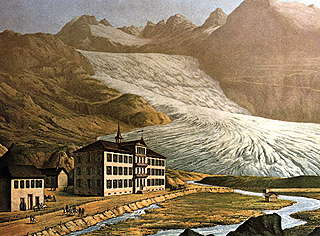
Rhône glacier ca. 1870. Source: Wikimedia Commons
Tax records in Scandinavia show many farms were destroyed by advancing ice of glaciers and by melt water streams. Travellers in Scotland reported permanent snow cover over the Cairngorm Mountains in Scotland at an altitude of about 1200 metres. In the Alps, the glaciers advanced and threatened to bulldozed towns. Ice-dammed lakes burst periodically, destroying hundreds of buildings and killing many people. As late as 1930 the French Government commissioned a report to investigate the threat of the glaciers. They could not have foreseen that human induced global warming was to deal more effective with this problem than any committee ever could.
Flourishing of European culture
Despite the difficulties in marginal regions, culture and economy were generally flowering in Europe during the Little Ice Age. This is most visible in the way that people transformed their environment during the 17th and 18th centuries with expanding agriculture and large scale land reclamation, for example in the Netherlands and England.
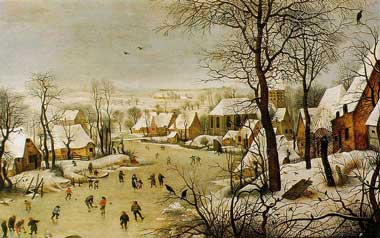
Winter landscape by Brueghel the Elder.
Source: Wikimedia Commons
The Little Ice Age also coincided with the maritime expansion of Europe and the creation of seaborne trading and later colonial empires. First came the Spanish and Portuguese, followed by the Dutch, English and other European nations. Key to this success was the development of shipbuilding technology which was a response to both trading, strategic but also climatic pressures.
Art and architecture also flourished, which is probably best embodied in the wonderful winter landscape paintings which can be considered a direct result of the Little Ice Age. These paintings show us ice-skaters enjoying themselves, a sign that they were more than capable to withstand the hasher winter conditions and that they had also enough food (Robinson: 2005). The latter is a key element in the success of European culture at that time.
On balance, the Little Ice Age affected northern European history in different ways. Regions that diversified agriculture and had good access to the international trade network, like Britain and the Low Countries, could cope quite easily with increasingly severe weather conditions. They could import food when harvests failed. Trade also gave them the financial base to develop technological responses.
In isolated regions, like high alpine areas of Switzerland, the Highlands of Scotland or Iceland, the unfavorable condition of the Little Ice Age, especially cold springs and harvest rains as well as longer winters, strongly influenced grain prices and were drivers for local famines. In central Europe the Little Ice Age was characterized by increased droughts as well as by increased flood frequency. Generally, the impact on different parts of Europe differed considerably. Some regions thrived while others struggled.
What caused the Little Ice Age?
The earth does not have some magical average natural temperature to which it always returns. If it warms, the earth must be receiving more heat or retaining more heat. If it cools, then it must be receiving less heat from the Sun or radiating more into space, or both. Is that what happened during the Little Ice Age?
Maunder Minimum
The exact cause of the Little Ice Age is unknown, but there is a striking coincidence in the sunspot cycle and the timing of the Little Ice Age. During the Little Ice Age, there is a minimum in sunspots, indicating an inactive and possibly cooler sun. This absence of sunspots is called the Maunder Minimum.
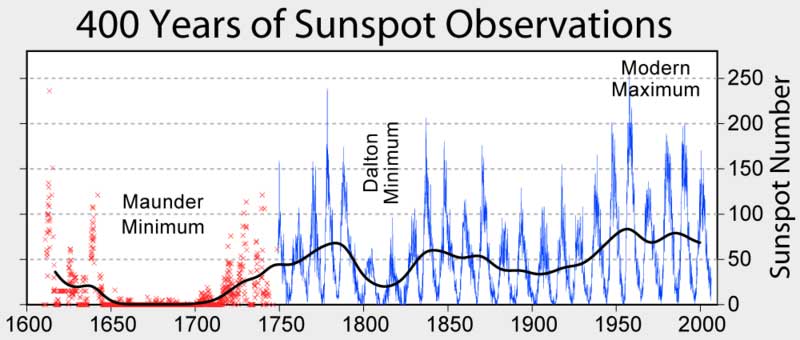
Source: Wikipedia/ Robert A. Rohde
The Maunder Minimum occurred during the coldest period of the Little Ice Age between 1645 and 1715 AD, when the number of sunspots was very low. It is named after British astronomer E.W. Maunder who discovered the dearth of sunspots during that period. The lack of sunspots meant that solar radiation was probably lower at this time, but models and temperature reconstructions suggest this would have reduced average global temperatures by 0.4ºC at most, which does not explain the regional cooling of the climate in Europe and North America.
North Atlantic Oscillation
What does explain a drop of up to 2 degrees C in winter temperatures? The North Atlantic is one of the most climatically unstable regions in the world. This is caused by a complex interaction between the atmosphere and the ocean. The main feature of this is the North Atlantic Oscillation (NAO), a seesaw of atmospheric pressure between a persistent high over the Azores and an equally persistent low over Iceland. Sometimes the pressure cells weaken and that has severe consequences for the weather in Europe.
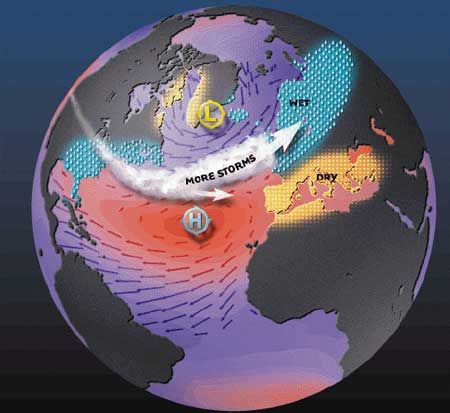
Positive North Atlantic Oscillation.
Image Courtesy Martin Visbeck
When the Azores high pressure grows stronger than usual and the Icelandic low becomes deeper than normal, this results in warm and wet winters in Europe and in cold and dry winters in northern Canada and Greenland. This also means that the North Atlantic Storm track move north, directing more frequent and severe stroms over northern Europe. This situation is called a Positive NAO Index.
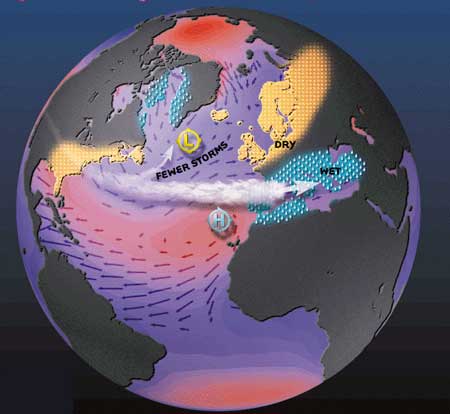
Negative North Atlantic Oscillation.
Image Courtesy Martin Visbeck
When both pressure systems are weak, cold air can reach Northern Europe more easily during the winter months resulting in cold winters and the North Atlantic strom track is pushed south, causing wet weather in the Mediterranean. This situation is called a Negative NAO Index.
It is now thought that during the Little Ice Age NAO Index was more persistent in a negative mode. For this reason the regional variability during the Little Ice Age can be understood in terms of changes in atmospheric circulation patterns in the North Atlantic region.
 Previous page: Reconstructing past climates
Further reading
Dodgshon, Robert A., ‘The little ice age in the Scottish Highlands and Islands: Documenting its human impact’, Scottish Geographical Journal, Vol. 121, No. 4 (2005), 321
Fagan, Brian M., The Little Ice Age: how climate made history, 1300-1850 (New York: Basic Books, 2000)
Le Roy Ladurie, Emmanuel, Times of feast, times of famine: a history of climate since the year 1000 ( London: Allen & Unwin, 1972)
Mann, M. E., ‘Medieval Climatic Optimum’, in Michael C. MacCracken and John S. Perry (eds.),Encyclopedia of Global Environmental Change
(vol. 1, Chichester: John Wiley & Sons, Ltd, 2002), 514–516. Access at:http://holocene.meteo.psu.edu/shared/articles/medclimopt.pdf
Pfister, C. and Brazdil, R., ‘Social vulnerability to climate in the “Little Ice Age”: an example from Central Europe in the early 1770s’, Climate of the Past Discussions, Vol. 2 (2006), 123-155. Access at:http://www.clim-past.net/2/115/2006/cp-2-115-2006.html
Robinson, Peter J., ‘Ice and snow in paintings of Little Ice Age winters’, Weather, Vol. 60, No. 2 (2005), 37-41


Recent Comments